

In the Age of AI, Some Things We Still Choose to Do by Hand
Journal / At the Worktable
In the Age of AI, Some Things We Still Choose to Do by Hand
“Done” on a screen feels different from “done” beneath a brush.
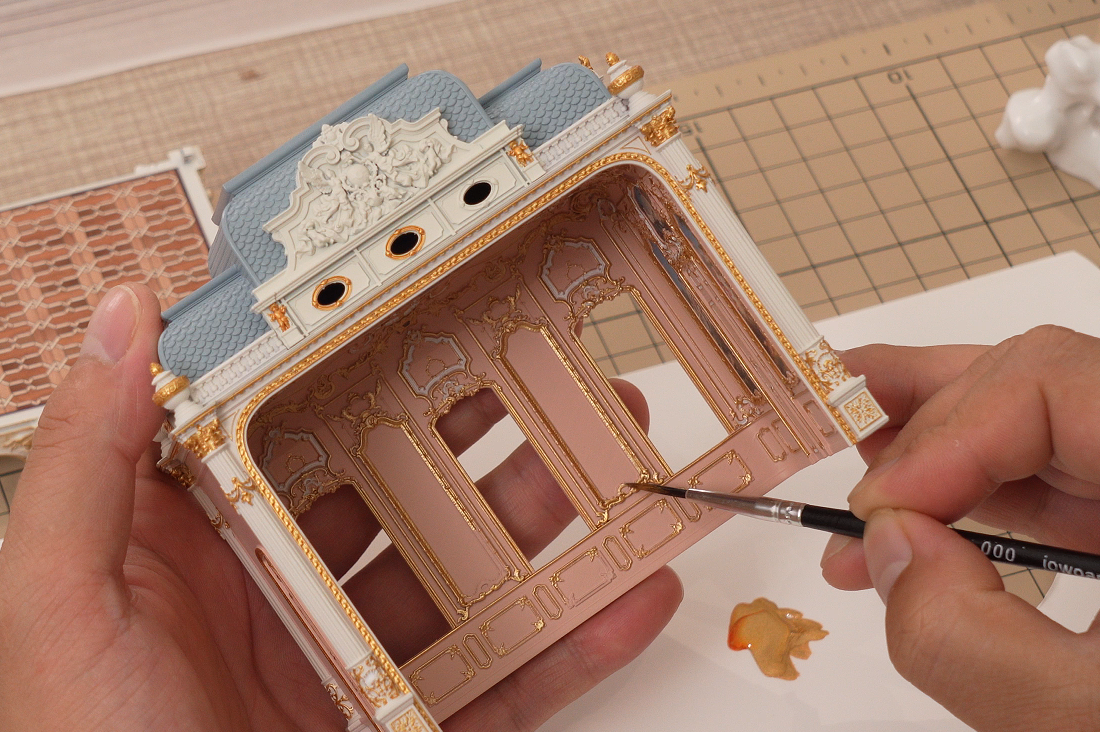
A Very Fine Edge
On a miniature window, a very fine edge separates the frame from the wall.
From a distance, it belongs to the architecture as a whole. Move closer, and you can see where one colour needs to stop: the frame must remain distinct from the wall, while the recessed surface keeps its own depth.
That edge will never be a piece of art on its own. It may not even be something you notice at first.
Yet while it is being painted, it deserves someone’s full attention.
At Horizon Diorama, every architectural miniature receives at least 60 hours of hand-painting. That number fits easily into a product description. In practice, those hours are spread across a window corner, a length of cornice, a small relief, and edges that only become visible when the piece is turned in the hand.

Our Sense of Waiting Is Changing
Today, a piece of writing we do not know how to begin can quickly become several possible drafts. An unfamiliar idea can be explained another way, whenever we need it. An imagined building can become an image with shape and colour in moments.
Understanding still takes practice, but getting started often feels easier than it once did.
We welcome that change. Horizon Diorama uses digital design and 3D printing to turn architectural ideas into resin models. These tools help us create intricate forms and explore more possibilities.
Then the physical model is placed in front of us, and time becomes tangible again.
On a screen, a window can be enlarged until it fills your view. In your hand, it remains very small. The brush must meet that actual scale. The paint must find its place on that actual surface.
There is no progress bar to tell you whether this particular stroke is good enough.
Applying Colour Is Only the Beginning
Spread colour too widely over a narrow decorative line, and a crisp detail can begin to feel heavy. Treat the raised and recessed parts of a relief too similarly, and the shapes remain physically present but become harder to read.
Gold, too, needs restraint. More brightness does not automatically create more refinement. Its edges matter, allowing neighbouring colours and the architecture’s own lines to remain visible.
“Finish painting this section” barely describes these decisions.
Often, the important part is where two colours meet. Has the paint softened a shape that should stay distinct? Has a slender line lost its delicacy? Has filling every surface evenly made the architecture feel flatter?
Hand-painting takes time because these questions take attention.
Before the brush touches the surface, there is looking. Afterwards, there is looking again. Turn the piece slightly, and something that was difficult to see may become apparent.

The Next Piece Requires Attention Again
We recognise the value of standardised production. Consistent dimensions and dependable quality make good design accessible to more people. That matters.
But at the hand-painting stage, finishing one piece does not complete the work of the next.
The architectural design may be the same. The colour palette may follow the same direction. Individual brushstrokes still vary slightly. An outline may be a little lighter; a transition between colours a little softer. Place two pieces side by side and look closely, and those differences can be found.
They are not deliberate marks added to prove uniqueness.
They come from something more ordinary, and more personal: someone picked up a brush again and gave this particular piece their attention.
We Want to Be Honest About Imperfection
Hold a piece closer, and you may also notice that an outline is not mechanically uniform, or that a tiny corner falls short of an imagined, flawless finish.
We do not want to describe every imperfection as “the charm of handmade work.” Something that needs refining still deserves to be refined. Hand-painting does not lower the standard we work towards.
Nor do we want to promise that every stroke will match the previous piece, or that every detail will be absolutely flawless.
The reality of handwork includes both the effort to achieve precision and the small variations that cannot be entirely removed.
What matters to us is the care behind that effort: defining the edge of a window, bringing out the depth of a relief, and looking once more at an area just completed—even while knowing that absolute perfection will remain beyond reach.

What We Hope Remains Is the Care
Our affection for architecture eventually has to become something specific.
Why keep a cornice so clearly defined? Why give a small window corner more attention? Why continue working once a model is already recognisable?
Because the longer we look, the less willing we are to finish carelessly.
Beyond the outline, there is structure. Within the decoration, there is order. Once one detail has been carefully finished, the detail beside it deserves the same attention. Our enthusiasm for these buildings gradually becomes part of the colour and brushwork.
The piece you receive may share its design with another, but every hand-painted mark will not be identical. Its individuality comes from the process of being finished separately.
AI helps us see possibilities and makes many things faster. We still choose to give these small buildings a kind of time that the word “generate” cannot fully describe.
As results become easier to obtain, we still care about how something is made.